Tuesday, October 9, 2012

Pay No Attention to the Man Behind the Curtain


Pay No Attention to the Man Behind the Curtain:

Dems post-debate strategy furthers public mistrust.


Mistrust of government and those in power is as old as our nation and to an extent often viewed as healthy. With modern media, people can observe certain events firsthand and are not left to journalistic conclusions or governmental reports. People are in a better position to challenge or simply not believe assertions made by those in power. This is what happened as 70 million watched a debate that revealed Mitt Romney is a real person and not the caricature drawn by hundreds of million of dollars in advertising and media dissemination.

It is easy enough to understand from recent events why the public would be skeptical of government and those in power. The public was told the bank bailouts and the stimulus bill were needed to save the economy. The economy has underperformed and the actions have disproportionately helped cronies and those with power. But it is hard to convince people that the counterfactual action was preferable- leeway in judgment was granted. The affordable care act was partisanly pushed into “pseudo” law. The President says it was the right thing to do. But it is hard to convince otherwise since large portions of the law have been outsourced to regulators and are yet to be written. Even the general outline and consequences of the bill have been hardly read let alone understood. People are skeptical, but grant a benefit of doubt until they understand it better. The Federal Reserve asserted there was no housing bubble, followed by saying it was contained to sub-prime, and now argues that continually funneling cheap money to banks and bank owned assets will help turn around the declining housing market and economy. We know they were wrong before and we are yet to see conclusive results now. Fortunately for the Federal Reserve board, they are not subject to public elections.

President Obama usurped congressional authority by executively enacting parts of the proposed “dream act.” The actions may not have been legal, but you don't see actionable congressional backlash and there is a consensus that general immigration reform and border protection needs to happen. The benefit of a doubt can be given to the President, he says it was the right thing to do. A similar benefit could be granted for the explanations to economic setbacks the last few years- a Japanese typhoon, bad weather, European problems among others.

In some situations, time has a way of clarifying doubts. President Bush said Saddam Hussein had weapons of mass destruction (WMDs). There was skepticism but many granted a benefit of a doubt. Great efforts were made to find the alleged weapons of mass destruction but over time the search proved fruitless. The administration unhappily admitted their error, but they dealt with the situation- they reaped what they had sown.

A pernicious trend has eroded the heretofore granted benefit of a doubt. Those in power have denied what the American people could plainly see or discern from modern media and did not do what was right or reap what they had sown. The trend is not just in politics.

In 2010, a Detroit Tiger pitched what would have been a perfect game. An umpire admittedly made a wrong call on what would have been the final play and spoiled the achievement. The baseball commissioner failed to overturn the call and do the right thing. Just days ago, an umpire made an errant infield fly call that altered an important baseball playoff game. Those with the power to do the right thing, did not.

A blown call by NFL replacement referees was shocking enough to resolve a lock-out, but those in power did not admit a mistake in the call or do the right thing. Where is the accountability?

Tragically, our ambassador to Libya was attacked and killed at a United States consulate by militant terrorists. The administration has admitted no culpability, has advanced a false narrative and has yet to do the right thing in admitting any mistake. They have yet to offer an explanation to these actions and though the benefit of the doubt may slightly exist, each day without an answer it is eroding.

All of these are examples where the American people could plainly observe that those in power were supplanting truth and logic.

Nobody likes a liar. While political junkies debate strategies of messaging, obfuscation, and ad personam attacks, the American electorate is forgiving. They understand that candidates over-promise, generalize and mischaracterize their opponents. One thing they do ask is that candidates reap what they sow, admit mistakes and not treat the American people as fools.

The Obama campaign's assertion that Romney cheated and lied to “win” the first debate was exactly the wrong strategy. It actually begins to conflate President Obama's remarkably healthy 50% approval rating with one of the issues which his campaign wishes to run on- the 70% of those who distrust the government to “do the right thing.”

The power of modern media was wielded masterfully by the Obama campaign up until recently. At moments they overreached, but overall they succeeded in creating a caricature of Mitt Romney and defined a narrative which hampered his electability.

This effort evaporated as the American people watched the first debate. Romney was not a fictitious monster. And for a reason yet to be known, President Obama was passive in reinforcing his campaign's assertions. Worse, President Obama was equally as passive and unprepared in effectively defending his own policies. Viewers could see that the truth of Romney and Obama had been supplanted by a false narrative.

The same thing is occurring with the explanation from Obama's campaign for the poor debate performance. The media and the campaign portray the President as omnipotent in thought, substance, and communication yet he was unable to retort basic accusations during a debate- or as the wizard from the Wizard of Oz said: “I'll have to give the matter a little thought; go away and come back tomorrow.” “Pay no attention to the man behind the curtain” it is Romney you have to worry about- he is cheating and lying. Blame the other guy.

Mr. President, as Dorthy said- “If you were really great and powerful, you'd keep your promises” - you would reap what you have sown. You did not and now you refuse to do what is right- admit you had a bad night.

A simple claim of having a bad night could have assuaged the poor performance. The claim that Romney cheated and lied, whether true or not, does not dismiss Obama's own woeful performance. What it does is pull back the curtain of the Obama machine and activate the evolving mistrust of those in power. 

Thursday, April 26, 2012

An interesting Jeopardy Like Question


I have been fascinated the last few years with shouts of "unprecedented", "never seen before",  "things are different!"
I never gave full attention in school, but most students remember the answer to "why do we have to learn history?" So you can learn from it and hopefully avoid the same mistakes.  It seems that those in the position to do the most either ignore the lessons of history or are ignorant of them.  So check out the following Jeopardy style answer:

    He made promises to voters of new prosperity. He was a substantial victor in an election with high voter turnout. It was universally believed he would work wonders, a sort of superman, no problem beyond his capacity.

When he took over the presidency, the Wall Street debacle was already whirring. He could have allowed the artificially low interest rates to rise to their natural level, but government-induced cheap credit was the bedrock of policy. He could let the stock and real estate market liquidate and purge the economy. But that would have meant lower wages and higher unemployment. He decided he would not follow the advice of the liquidationists. He therefore agreed to take on the business cycle deleveraging and stamp it flat with all the resources of the government. He said that the times were unprecedented and required pioneering a new field. He resumed credit inflation with the Federal Reserve adding large amounts of credit. He held conferences with industrial leaders urging to keep employment and wages steady. The labor unions supported and praised this policy. Prominent economists praised his moves and called federal credit expansion the right solution. He increased government spending. He deliberately ran up huge deficits, increasing the government's share of GNP. This was the largest-ever increase in government spending, most of which was accounted for by transfer-payments. He tried to channel government money through the banks and used government cash to try and reflate the economy. He started programs of government intervention to target money to special interests.

When intervention failed to produce the desired results, he doubled and redoubled his efforts. He increased the cash and credit available to his intervention programs. He ignored or bullied Congress, running the administration like a dictator. By this point, however, he had lost control of Congress, which was horrified by the deficit and insisted that the budget had to be brought into balance. The push in Congress was to increase taxes, with the rate on high incomes jumping.

Mostly neutered by Congress, the President still had his interventionist rhetoric and continued louder than ever. He announced if they did nothing it would be utter ruin.

His rhetoric persuaded the financial community that he was pro-labor and anti-business, furthering the deflationary pressures on the economy. This was reinforced by his incessant attacks on the stock exchanges, which he regarded as parasitical. His demand to regulate and investigate Wall Street kept stocks depressed and discouraged private investors. His policy of public investments prevented necessary liquidations. The businesses he hoped to save either went bankrupt in the end or were highly indebted.  He undermined property rights and contract laws by weakening the bankruptcy laws and encouraging moratoriums on debt sales and foreclosures. This impeded the ability of banks to maintain confidence and clean up their balance sheets. After pushing federal credit into the banks he bullied them to increase loans and inflate the economy, a move which would increase the precariousness of the bank's positions.

The Presidents interventionist policies had prolonged the downturn, but it did not stop the unemployment number from increasing. The young artists and academics were empowered to criticize and be hostile towards the structural ideas of free markets, capitalism, individualism, independence, and personal responsibility. They were exhilarated at the unexpected collapse of the “gigantic fraud.” And they instinctively began to support public planning, leaving behind a “period of extreme individualism.” Capitalists who disagreed “would be treated like any maverick... roped and branded and made to run with the herd.” The country could no longer afford “irresponsible, ill-informed, stubborn, and uncooperative individualism.”

Who was it?


Herbert Hoover  31st President 1929-1933

Does the above parallel what has happened recently? Definitely has similarities. Here is what happened (possibly happens) next.

A large blow to the economy came when Europe's economy began to slow. Large European debt had been accumulated and after a leading European bank collapsed the European dominoes began to topple. A U.S. Plan to intervene came too late and other European banks began to shut. Debt repudiation ensued and rampant currency devaluation began. European markets became detached from the U.S and foreigners began withdrawing their U.S. Holdings from U.S. Banks. U.S. Depositors followed suit and a classic bank run brought the system to a standstill.

Landlords had difficulties collecting rent and so could not always pay taxes. Municipal revenues collapsed, hampering the welfare programs and municipal services. Schools were shut, teachers laid off and colleges went bankrupt and shutdown.

Basically, the Great Depression happened. Can we avoid it? I don't know. But I can at least prepare for what I know has happened before, now that I know some more history.

Monday, November 28, 2011

Embezzlement is a Crime Mr. Corzine

A nice explanation of what may have occured at MF Global can be found here.

Prosecutors need to be reminded of the 100′s that went to jail over the S&L crises. Also of interest may be former exchange president Richard Whitney who went to jail for, like Corzine, the crime named embezzlement. Responsible citizens need to ask why these crimes are being selectively (if at all) prosecuted and demand action.
If John Doe steals a hundred dollars from a bank, he goes straight to jail.
If John Corzine embezzles up to $1.2 billion, he resigns and says “my bad.”

Embezzlement is the act of dishonestly appropriating or secreting assets by one or more individuals to whom such assets have been entrusted


The Commodities Exchange Act, 7 U.S.C. § 13(a)(1), makes it a crime punishable by up to 10 years imprisonment for anyone associated with a commodities dealer
to embezzle, steal, purloin, or with criminal intent convert to such person’s use or to the use of another, any money, securities, or property having a value in excess of $100, which was received by such person or any employee or agent thereof to margin, guarantee, or secure the trades or contracts of any customer or accruing to such customer as a result of such trades or contracts or which otherwise was received from any customer, client, or pool participant in connection with the business of such person.

Friday, September 30, 2011

Kids on Taxing the rich... Fed & Bernanke counterfeiting

GMA clip 9/29/11.

IF you don't like paying higher taxes "you're greedy."

Kid solution on bringing America back: put money in printer and make more money.  

Future Fed head alert, look out Bernanke.


Kids Don't think Obama Re-elected

A clip from GMA 9/29/11. Kids don't think Obama to be re-elected, offer advice of more job availability.


Thursday, September 29, 2011

The Case For Barnes & Noble: Amazon

The performance of Barnes & Noble (BKS) shares compared to Amazon (AMZN) can be seen from this Google chart:

For many reasons Amazon is doing well and Barnes & Noble is under pressure and without a change may go the way of Borders, bankrupt.

Most people have heard the story or been the subject themselves of browsing in a Barnes & Noble brick and mortar to find and review a product and then, having compared costs, ordered the product using Amazon.
Or have you witnessed the "customers" that enjoy casually sitting and reading in the B&N store rather than purchasing the product and reading it elsewhere.

As stated, there are many reasons for the bifurcation in these companies performances.

There are many reasons to think B&N will have trouble surviving without a change. However, one reason to consider investing in BKS is ironically the company that is pressuring its sales, Amazon.

Amazon is under pressure from cash strapped states to implement a sales tax.

One could reasonably suspect that this sales tax drive will eventually take place. At that point, I think Amazon would seriously weigh the pros and cons of establishing a physical presence, brick & mortars. Barnes and Noble would be an attractive way of establishing this physical presence; Amazon may buy B&N.

Amazon has established customers across a broad range of products and is becoming more entwined with its customers daily lives. What better way to promote itself, provide superior customer interaction, and be a resource to the community as a social gathering spot than by a physical store presence?

In addition, Stifel Nicolaus & Co. analyst David Schick says a Barnes and Noble purchase would bring Amazon B&N's "competitive advantage... in its relationship with publishers and heavy readers, ... relationships...strengthened with Borders going out of business."

Amazon's focus on online media could gain tremendous boost utilizing B&N's existing college presence.

AMZN may buy BKS and figuring out when and at what price may be worth thinking about.

Saturday, September 24, 2011

HFCS High Fructose Corn Syrup

Just watched a commercial that fails the logic test.


The commercial says studies found that HFCS has an affect similar to sugar in humans.
It implies that there is nothing to worry about in consuming HFCS.

This implies that there was a current concern about consuming HFCS.

'A' is possibly bad.
It is found that 'A' is similar to 'B'.
Therefore....?
Well, according to the commercial 'A' is now okay!

What about the possibility that 'B' may also be bad?

I'm not going to say that sugar is bad. What I will say is that excess sugar is probably not good for anyone.

The average amount of sugar consumed in a year by Americans has increased 100lbs in the last century. 

We know how sugar affects insulin levels and we know how powerful insulin is.
We know that cancer cells feed off of sugar.

Why do we continue to ignore the science that has won multiple Noble prizes for its researchers?

$$$$$$$$$$$

HFCS is cheap compared to sugar. Sugar is sweet. People like the taste of it and the insulin response to sugar.  It is a potentially deadly cycle, an addiction that is being exploited for profit.


Just found this commercial that has the actress hastily mumble "its fine in moderation."  I guess the lawyers got in on that one.

Friday, September 23, 2011

Einstein Wrong. Physicists fail to think. Grand Unified Theory Possible.

Analysis of this article gives credence to many of the thoughts I have had the last few weeks.
Physicists who measured particles traveling faster than speed of light don’t dare dream
The thoughts:

1.Einstein was wrong.
2. Time is not real.
3. The speed of light is not a barrier.
4. Time travel and dilation are a farce
5. Simple thought experiments can invalidate explanations of Einstein's theories.
6. A Grand Unified Theory (GUT) has been hampered by an unwillingness to consider Einstein wrong.
These thoughts were prompted from a TV show discussing the possibility of time travel.

Time is not real, it is a derived measurement. Time can be many things- the displacement of sand by gravity, the period of a pendulum, the frequency of microwaves from cesium. You can not add to it or take away from it. It has no absolute beginning or end. It is a relative measurement that has no meaning beyond what we give it.

A "subatomic particle, the neutrino, was found to have outrun light and confounded the theories of Albert Einstein.
To our great surprise we found an anomaly,”

No! You measured a result. It is only an anomaly to the special theory of relativity.
“Everybody knows that the speed limit is c, the speed of light. And if you find some matter particle such as the neutrino going faster than light, this is something which immediately shocks everybody, including us,”
No! The speed of light is the speed of light. Don't blame everybody for the scientific community's assumption of correctness to Einstein's theory.
Example:
"Alvaro De Rujula, a theoretical physicist at CERN...blamed the readings on a so-far undetected human error... (people) could, in principle, travel to the past and kill their mother before they were born."

Speed of light must be speed barrier and we can manipulate time and events, Einstein said so. WHY would you accept this?

Stop assuming Einstein was right and lets get  a GUT. I can't always do the math but I can do the same thought experiments that Einstein proposed and see their fallacies.

Random Thought

The wisdom of various attempts to stimulate the economy is best described by paraphrasing Edison's aphorism: I haven't failed to stimulate the economy, I've found dozen of ways that don't work

Questions not being asked: Boeing vs NLRB

Poor management is the real reason why Boeing is building in South Carolina. Management is establishing a track record of poor forecasting, inefficient and wasteful production, poor product quality oversight, creating an uninspiring working environment, and waste in general.


Boeing executive Jim Albaugh telling a reporter why they decided to move the 787 Dreamliner assembly line to South Carolina:
The overriding factor was not the business climate. And it was not the wages we are paying today. It was that we can't afford to have a work stoppage every three years.


Each element of his answer should be examined.

Why are there frequent work stoppages?
Why are wages an issue?
Why might there be a poor business climate?

I have visited Boeing facilities in Washington, Kansas, and its HQ in Chicago.
Wasteful bureaucracy at each one.

There are two ways for management to increase profits, increase revenue or decrease expenses thus improving margins.

Instead of cutting all the bloat resulting from poor management, Boeing continually feuds with its workforce.

So maybe the workers will not strike and create stoppages in South Carolina. Will this make the company any more productive. I doubt it.
The 787 program has been a disaster. Every investor and customer was excited about the 787's prospects and the ambitious time line. Delay, delay, delay, lack of this, failure of that; is there any excuse that we didn't hear?
Stop blaming others and take some responsibility Boeing management.

-------------------------------------------------------------------------------------------
Boeing has been around for nearly 100 years and has a market cap over $40 billion. Its main competitor is EADS.
Boeing is essentially a GSE- government sponsored entity. Nearly half of their revenue came from Boeing's Defense, Space & Security divisions. The majority of paperwork at the export-import bank has Boeing's title on it. Subsidies and sweetheart deals at the local level are undeniable.


Some days you just can't get rid of a bomb

The current state of the European economy:


Eventually the bomb will go off. When will the European leaders stop ignoring the problem?  Who is Batman and will they do the right thing?

Tuesday, September 13, 2011

Boom! Here comes the Boom! Ready or not, How you like me now?

The falcon cannot hear the falconer;
Things fall apart; the centre cannot hold;
-- The Second Coming; Yeats

The next few days will be tough for the markets.  Investors have been circling the pundits and leaders, slowly widening the gyre, until the falconer is actually ignoring the falcon, as in Europe, or is yelling at it to go away, as in the United States. 

Der Spiegel has the latest on Germany's response to the Greeks ouzo sipping ways. Meanwhile, Bloomberg LP reports Italy is looking for a China bailout. This will initially give some relief and a bounce, but I remember learning that the last money in before an economic bust is often of foreign origin. Prince Walid

I wrote about Greece default, by choice or by riot, and the resulting threat to the Euro structure in June elsewhere (Real Time Economics and others were also early to the game). The spotlight is finally being shown on the situation, but the Europeans are delaying and refusing to deal with their mess. Euro-zone chiefs fiddle while countries burn

In the US, President Obama presented his jobs bill.  Whatever you made of his proposals, many analyses are available, the tax proposals suggested to pay/off-set the proposed spending are coming into full view. 

The bill will restrict some tax exemptions of interest from municipal bonds. The municipal bond market will get killed; "It would be dramatic for municipal bond demand,” said Matt Fabian
It makes no sense to funnel money to the States and local government, as part of the proposed job bill, and at the same time raise their borrowing costs.
Other proposals to offset spending that will discourage risk investment are being found.

Regulations and a yield curve that helicopter-Ben is helping destroy is reshaping the banking industry (BAC layoffs) and most likely moving the financial centers to Asia.

The devaluation of the dollar and essentially negative real returns offered to government debt investors and money market/cd participants is pick-pocketing Americans.  The intentions are well thought out, encourage riskier investments like stocks or real estate, but the reality is that the moral hazard created by the bailouts, the lack of transparency by financial companies, and the lack of certainty in fiscal, monetary, and regulatory policy have created a warning to the investment community; don't trust the guys and gals with the rose colored glasses.


Competitive devaluation further distorts markets and money flow. Lets all buy some Krone!

I think we are at a bifurcation point, hope and wants versus reality.
The reality is Europe's leaders don't want to confront its failed systems. The United States' leaders don't understand simple economics. The falcons, the investors and citizen stakeholders, are no longer willing to dance to their promises and calls.

Things fall apart; the centre cannot hold.

Be careful these next few days.

Monday, September 12, 2011

Fed's Richard Fisher Confuses His Age For Wisdom

This morning on Bloomberg, Federal Reserve Bank of Dallas,@DallasFed, President Richard Fisher made snarky comments in response to Betty Liu, @BettyInTheLoop , and diminished the value of his interviewer, Sara Eisen, @saraeisenFX.
About 4 minutes in, Fisher says that the media is hyping the dissent from the most recent Fed meeting. Liu challenges him saying that the markets may have increased volatility due to the dissent. 

The lack of clarity in policy, monetary and fiscal, has been a key reason why investors have been cautious and unwilling to accept risk.

Fisher goes on to buffer his initial response by stating the obvious, he is much older than either of his two hosts. 

Richard Fisher's credentials are very impressive. However, he should be above diminishing others opinions due to his greater experience.

Who is to say his many years make him any more right than a five year old. For many economic questions, you would do just as well flipping a coin as you would listening to the experts. Actually, listening to the experts may be a good strategy, as long as you take the contrarion view.

"Wisdom doesn't automatically come with old age. Nothing does - except wrinkles. It's true, some wines improve with age. But only if the grapes were good in the first place"   Abigal Van Buren

"The surprising thing about young fools is how many survive to become old fools."  Doug Larson

Thursday, September 8, 2011

Sorry BAC, you can keep your "Book Value"

Bank of America Corp has an ugly chart.  Buffett and Berkshire cut their deal with BAC and Moynihan is crying out all clear. 

Bove says book value is this or that and that the stock should move from 7s to 10s. 

I have a feeling that BAC's own analyst, Guy Moszkowski, may agree with Bove.  I remember when Moszkowski maintained a "buy" rating on Bear Sterns @ 140 in June 2007. The price to book value was "1.3", significantly lower than peers like Lehman and Merrill that were at 2.2 and 2 respectively.  Bear, he wrote, is even a "manageable takeover candidate."

I also remember Bove riding down both BAC and Citigroup. 
Why don't the journalist preface any of his appearances with his track record? They used to display how the analysts picks have performed since the last time they spoke.  His track record has been horrible, sorry to say.

Bottom Line:

Why trust the analysts or the banks when it comes to book value?
The banks don't even trust each other?

People are having trouble finding jobs; either they can't find one or they found one but can't sell their house to move to the opportunity.

The unemployment rate and stagnant real-estate market continues to depress home prices and increase delinquency rates.

Bank of America is highly linked to the real estate market going forward and is highly linked to the real estate market of the last few year (lawsuits galore).

What is the "real" book value of BAC?  I doubt even the company itself really knows.  But even more, I bet noone in the company would want you to even begin to calculate it because it is certainly much lower than the on-book current evaluation.

Bloomberg detailed writeup
Moynihan Tries to Keep Bank of America Intact as Mortgage Loans Fall Apart

Yahoo Inside Trade On Bartz Firing?

At 4:58 PM EST on September 6th, eighteen-million shares of Yahoo! were moved at a net price of $ 12.90 per share- that is just over $232 million dollars.

According to a source, the e-mail sent by Bartz to Yahoo! employees was sent at 6PM EST.

Chart via Google:


Who leaked?

Wednesday, September 7, 2011

It’s Friday, Friday. Presidents gotta get down on Friday

According to sources on wikipedia, Presidents should be quick to duck on Fridays.


Kennedy was shot on a Friday.
Lincoln was shot on a Friday

McKinley was also assassinated on a Friday.

Garfield was shot on Saturday.

Andrew Jackson was shot at on a Friday.

A plot to kill Nixon by crashing a plane into the White House (sound familiar?) was foiled on a Friday.

Ford avoided an assasination attempt on a Friday and then two weeks later on a Monday.

Hinckley tried to kill Reagan on a Monday.

September 12th 1994 a man crashed a plane into the White House lawn (sound familiar), Clinton was not present that Monday.

The article is fascinating as I don't think most people would believe the amount of attempts to kill the Presidents of the United States.

Especially interesting to me was that a grenade was thrown at GW Bush and it did not detonate and kill him because of a handkerchief that was wrapped around it. Sounds like it was a close one but I don't remember hearing about it at the time.

+Update :
21-year-old Idaho man is charged with attempting to try to assassinate President Obama...allegedly shooting at the White House on Friday, Nov. 11, 2011

Internet used to prove teacher wrong on Kennedy-Lincoln Connection

An old worksheet I found from junior high social studies discusses the "Eerie Kennedy-Lincoln Connection." Some examples:
  • Lincoln was elected in 1860, Kennedy in 1960.
  • Lincoln's secretary, whose name was Kennedy, advised him not to go to the theatre.
  • Kennedy had a secretary named Lincoln (who was born 100 years after Lincoln, and whose husband's nickname was Abe) who warned him not to go to Dallas.
  • Both presidents were shot from behind in the head.
  • Both presidents were shot in presence of their wives.
  • Both presidents were shot on a Friday.
  • Both presidents were accompanied by another couple.
  • Both presidents' last names have 7 letters.
  • Both presidents have five syllables in their full name (which counts Kennedy's middle initial).
  • John Wilkes Booth and Lee Harvey Oswald each have 15 letters and 3 words.
  • There are 6 letters in each Johnson's first name.
  • Booth ran from a theatre to a warehouse, Oswald ran from a warehouse to a theatre.

This list continues, and as entertaining as it is, some of the statements are not fully true. A good discussion of the Kennedy-Lincoln list can be found at this webpage.

Sadly, this gimmicky list is more memorable than the usual worksheets used to teach and test in that class.

Here is an example of the typical worksheet with my answers:

  • What was the name of the play presented the night that President Lincoln was assassinated? Our American Cousin
  • Who was the star of the play? Laura Keene
  • Who was the conductor of the stage orchestra? William Withers Jr.
  • What song was to be played for President Lincoln that evening? "Honor to Our Soldiers"

Why was the gimmicky list memorable and the typical worksheet not?

The list made connections and implied patterns. The typical worksheet tests memorization and recall.

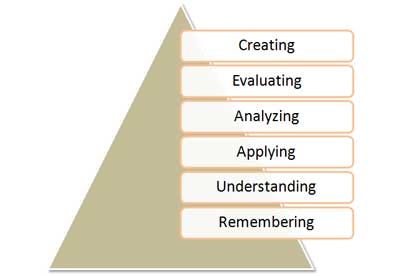
A formalized classification of this difference in learning is presented by Benjamin Bloom's Taxonomy.


Bloom says that there are different levels of learning, with knowledge being the lowest and the higher levels being comprehension,application, analysis, synthesis, and evaluation.

The characteristic that distinguishes a human brain from a computer is the ability to make connections and recognize patterns and learning at the higher levels of Bloom.


Unfortunately, teachers typically ask their students to define, label or name, questions at the lowest level. Those asked in my social studies class were at the lowest level.

The more appropriate type of question would evaluate if the students can make a connection and recognize patterns or lack thereof- compare, design, argue, distinguish, interpret, evaluate.

The answers to knowledge questions can now be found by an internet search, they are merely a statement of the written record.


With a few clicks to verify sources, students can now check their teachers by using the internet and they can also find related information to help learn at a higher level if their teachers are not providing that information.